
Scoreboard is still zero, but I changed approach.
The counter for the $168M challenge still reads fucking zero. That’s not quite honest, though. If I add up what’s gone out the door since I started- mostly hosting, tools, subscriptions- I’m not at zero. I’m in the negative.
I hadn’t been tracking that number closely because I’ve been heads down building, and somewhere in the last few weeks I nearly forgot the challenge was even running in the background.
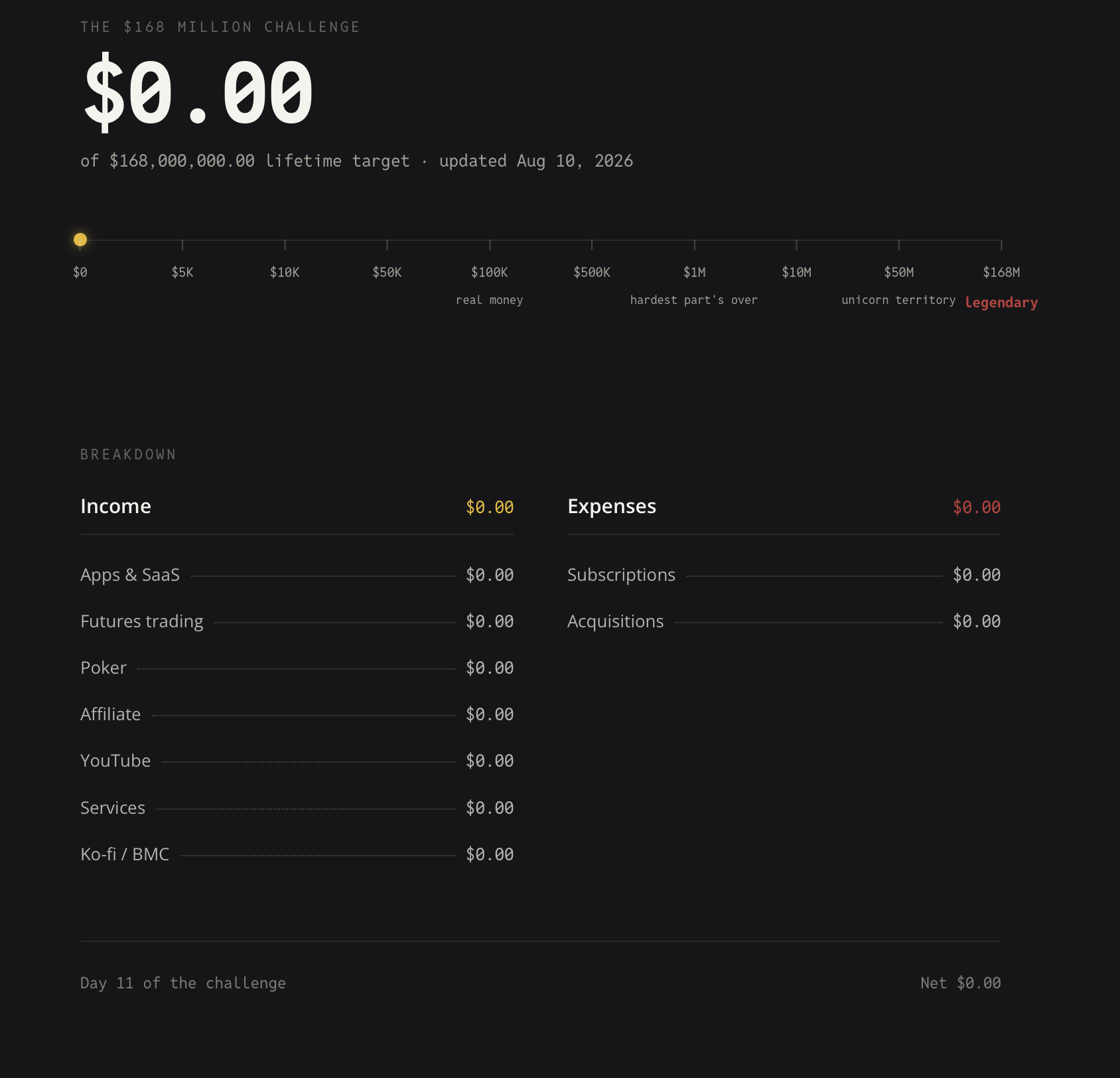
When I finally looked at it straight, that zero stopped feeling neutral. It started feeling like proof I hadn’t earned anything yet, even with everything I’d built.
I want to be transparent about that, because the whole point of documenting this publicly is to show the real shape of it, not a curated version where the losses are quietly left out.
It’s also worth saying: it’s early. None of what I’ve built is being actively marketed yet.
My flagship MVP is still pre-push, and there’s something else I’m building on the side that I think might end up being the best thing I’ve made, though I’m not ready to talk about it yet. So the zero isn’t a verdict. It’s a starting condition. But it’s still a number I have to sit with until something changes it.
Setting a real starting point
I had to stop and think. I could let the counter sit at zero, maybe negative, for months, waiting for the first dollar from the first SaaS subscriber to finally move it.
Or I could go back and set the actual rules of this challenge more carefully, in a way that’s still honest but doesn’t leave me stuck waiting indefinitely for a single trigger event.
I never said this had to start from a literal zero-dollar budget. That was never explicit. And honestly, it can’t be true anymore anyway. My build costs have gone up steadily since May 2026, so pretending there was ever a totally clean slate would be its own kind of dishonesty.
Read also: Subscription check: what I'm paying now, and what's coming
So the real dilemma became: how much starting capital do I let myself count? I could throw a large amount in and fast-track everything, buy every piece of hardware I want, remove every constraint, and just push hard toward the goal.
Or I could set something more modest, something that reflects how someone without unlimited resources might approach the same challenge.
I went with the second option. I’m counting half of my estimated hardware costs, 10K USD, as starting capital. Not the full amount. I could easily add the other 5K and call it done, but that would mean operating from a position most people reading this don’t have access to.
Not everyone can drop that kind of money upfront or already has revenue coming in to cover it. If this challenge is supposed to mean something to people following along, it needs to stay grounded in something achievable, not funded from an ivory tower.
That decision has a direct consequence: my hardware purchases now need prioritization. The upgrades that are genuinely necessary move forward. The ones that are just nice to have get pushed, possibly indefinitely, until the number justifies them.
Read also: I need a full hardware upgrade, and I have no idea where to start
Why this changes the whole approach
Setting that starting capital isn’t just an accounting decision. It changes how I think about the entire challenge going forward.
Before this, my only real path to moving the counter was waiting. Waiting for someone to subscribe to TWO Docs at $6 a month, one signup at a time, and hoping the number slowly climbs. That’s a fine long-term plan, but it’s a passive one, and passive doesn’t make for compelling documentation.
With a defined starting capital, I have room to be more deliberate. I can set aside a clear budget for subscriptions and tools, the actual cost of running these products, and use whatever’s left to explore other things.
Day trading. Online poker. High-risk activities, no doubt, and not something I’d recommend as a strategy to anyone reading this looking for financial advice.
But they’re also genuinely interesting to document. They generate their own stories, their own arcs, wins and losses I can write about honestly. And if any of that ever crosses back into the $168M number, even indirectly, that becomes part of the challenge’s story too.
I think that idea, using higher-risk personal ventures as parallel content that occasionally feeds back into the main challenge, probably deserves its own post once I’ve thought it through properly. For now I just wanted to get the thought down while it’s fresh.
What I’m watching for
The thing I keep coming back to is momentum. I’m currently ahead of schedule on my personal roadmap, further along than the updates I’ve already published would suggest.
That’s a good problem to have, but it’s also fragile. If I start layering in day trading, poker, and other side activities purely to accelerate the $168M number, there’s a real risk that instead of adding to the momentum, it fractures my attention and actually slows everything down.
Read also: The $168 million moonshot: a batshit crazy goal
So before any of this becomes action, I need to pause and map it out properly. That means going back to the drawing board on starting capital and writing a full, detailed post explaining the why, the how, and the actual numbers, so anyone following this challenge can see the reasoning, not just the outcome.
It means redoing the hardware upgrade list and making sure I stay inside the 5K budget I’ve actually committed to, not the 10K I was loosely circling before.
And it means figuring out, with real honesty, how much time and attention side activities can take before they start working against the roadmap instead of for it.
None of this shit changes the core challenge. The zero is still zero, maybe still negative for a while longer.
But at least now it’s a zero I understand, sitting on top of a foundation I can explain. That’s worth more to me right now than a number that moves for the wrong reasons.
Get new posts before anyone else
No noise, no automation sequences. Just what I'm writing, thinking about, and building, sent when there's something worth sending.
An email once in a while. Unsubscribe anytime.

Written by
Pieter Borremans
Writer·Content creator·Founder
Based in Taichung, Taiwan and London, UK, this is Pieter's personal journal and builder's blog: field notes on entrepreneurship, solo business-building, and the unfiltered reality of creating online. Alongside it, he's chasing one absurd goal in public, $168M USD in lifetime earnings, tracked live from zero.