
My podcast stats are a bit surprising
I've been deep into building five podcast channels. Besides writing, most of what I make these days is audio.
The focus is very much on three of them, all tied to English learning. Two are for adults, and one is for kids at A1-A2 level.
I needed a break from building the native Mac app. My Claude limits are running out faster than I imagined, so it felt like a good moment to sit down and go over my podcast stats.
Read also: How do you vibe code a Mac app? Part 4: limits & 90% confidence
I was highly motivated going in. My numbers in the Spotify for Creators dashboard were looking good.
The problem was that I was only looking at Spotify. I didn't include Apple Podcasts at all.
Some context first
Exactly a month ago, I started Story Valley, my English learning show for kids. I uploaded it to Spotify, but a tiny oversight made me forget to import the feed into Apple Podcasts. I fixed that and added it to Apple on September 27th.
That also meant adding Study Brew to Apple Podcasts right when it launched.
A while back, I wrote in one of my blog posts that Spotify is a great channel, but the best version of it sits behind a paywall. Not everyone wants to listen to English learning stories interrupted by ads. Let alone put them on for a kid.
The YouTube bet
So my bet was that most of the audience would find these shows on YouTube instead. It's free, it's accessible, and which parent doesn't use YouTube?
But my YouTube stats aren't that dazzling for every channel. Maybe it's too early to tell. One to three months on YouTube doesn't say anything.
Except... Story Valley.
That one seems to have been the right decision. Not because of distribution, but because of the niche.
The oddest part is that Story Valley is starting to surpass Story Brew, the OG of my podcast channels.
Plays that don't turn into listening
The plays and downloads look good. The consumption time doesn't.
People on Spotify seem to treat the show like a TikTok feed. Tap play, listen for a bit, move on to the next thing. You can see it in the average consumption time per episode, which isn't impressive.
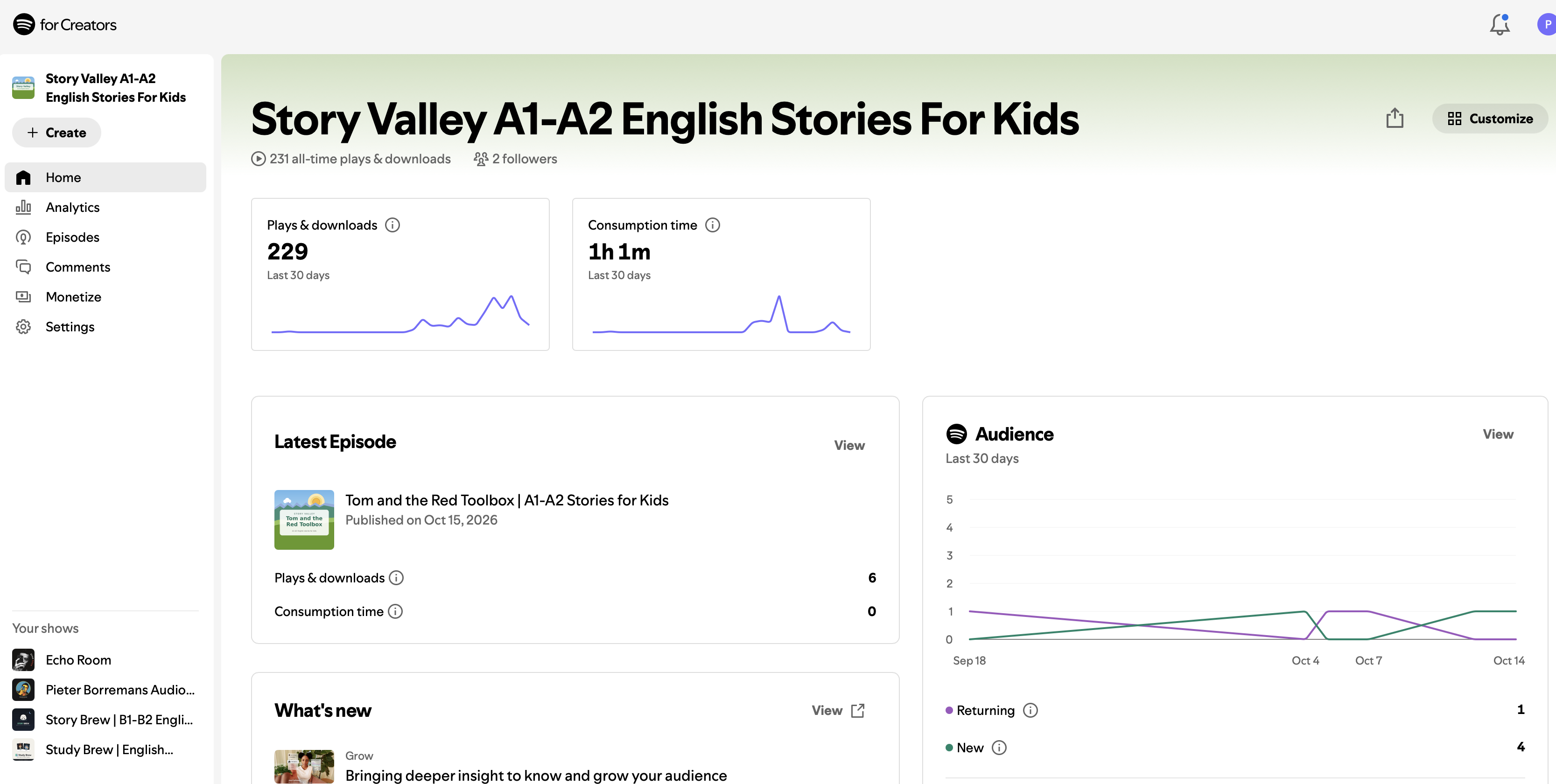
A play counts the same whether someone listens for thirty seconds or the whole story. So a high play count with short listening tells me people are finding the show, but they're not staying.
Plus, it has two followers on Spotify. One of them is me.
I'm not dismissing Spotify in general. But for this type of content, the audience there is fickle.
Story Brew, the show I started with, is a different story. It targets adult English learners at B1-B2 level, and its numbers are more stable and make more sense.
Then I opened Apple Podcasts Connect
I totally forgot that Apple Podcasts has its own analytics dashboard in Podcasts Connect for every show.
When I opened it, I almost dropped to the floor. Compared to Spotify, it's a completely different picture. My instinct was only half right, if not totally wrong.
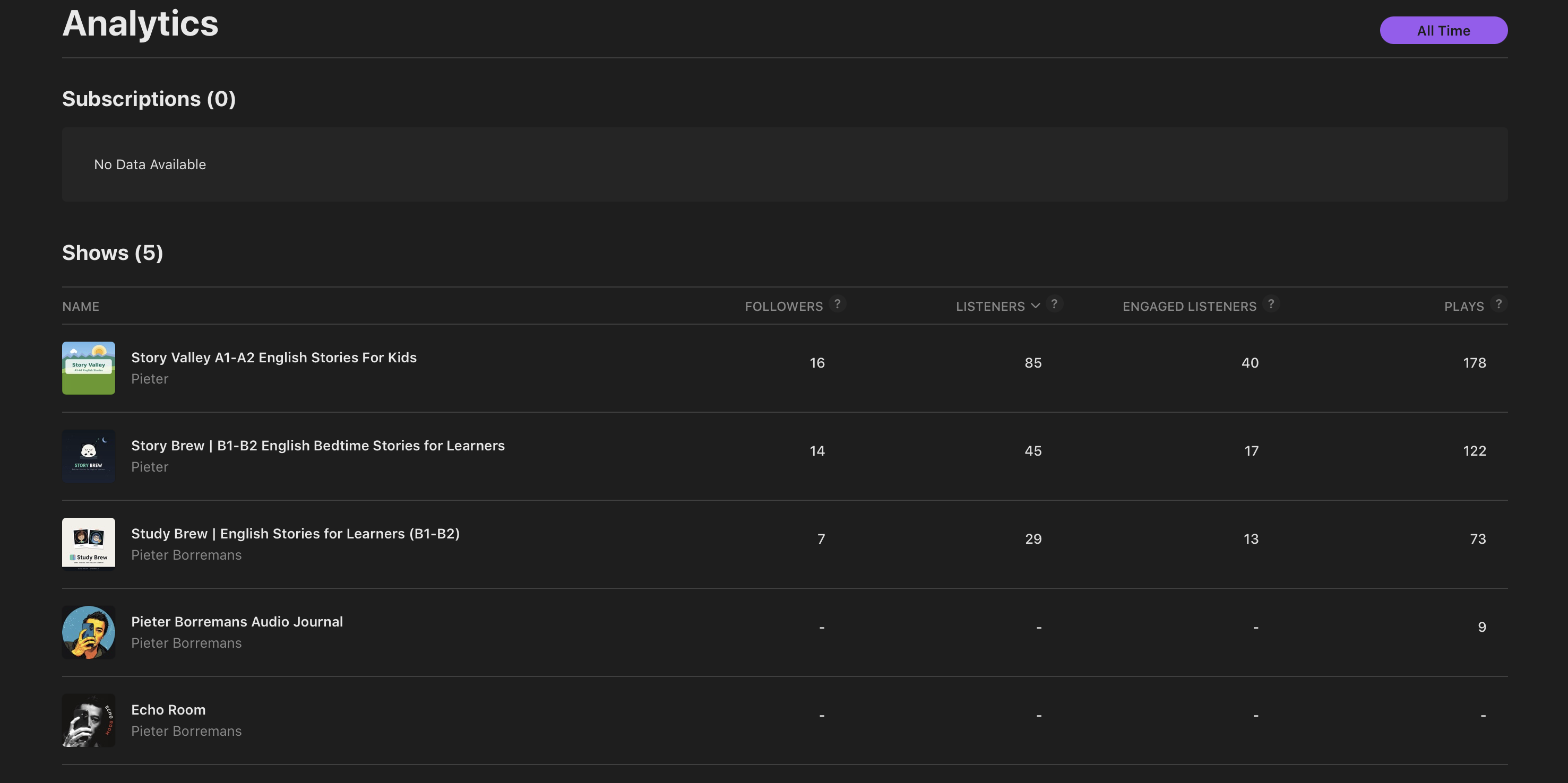
I expected YouTube to surpass Spotify. Instead, the real audience is apparently on Apple Podcasts. For every single English learning channel.
The numbers, show by show
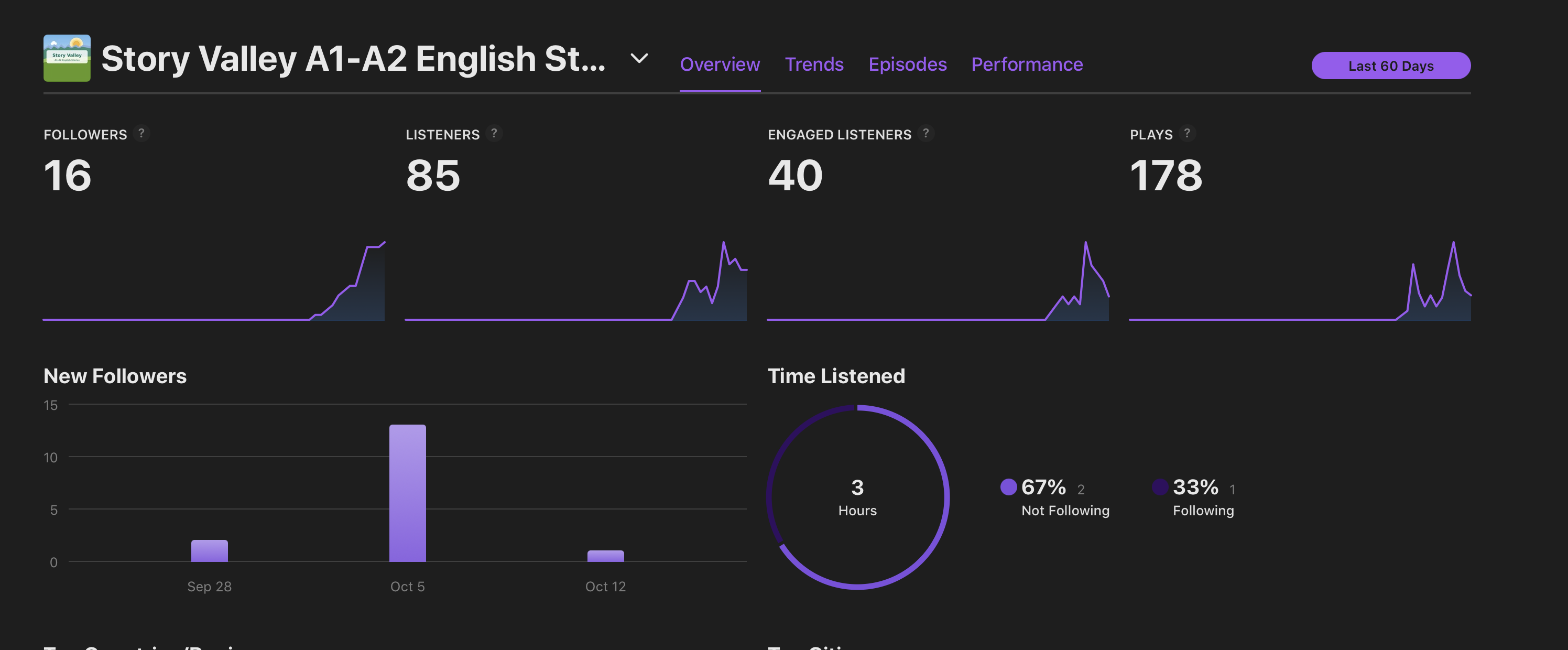
Study Brew launched on October 8th, only a week ago. It already has six followers on Apple Podcasts, and zero on Spotify.
Story Valley went live on Apple Podcasts on September 27th and picked up 16 followers. On Spotify, it has one, not counting me. And it's been on Spotify almost two weeks longer.
Story Brew has been live on both platforms since April. It has 20 followers on Spotify and 14 on Apple Podcasts. But the listeners on Apple are more engaged, with a higher average consumption time.
Put those side by side, and Story Valley got more followers on Apple in under three weeks than Story Brew did in six months.
I completely underestimated how powerful Apple Podcasts is. Right now, it looks like my best shot at reaching the right, engaged audience.
The retention rates and the follower count in such a short timeframe are pretty mind-boggling.
I don't know how to optimize any of this
My problem is that I don't know how to optimize for Apple Podcasts. Or Spotify, for that matter.
Right now, I throw every episode online with a description, and that's it. I wonder if there's a method to make my shows easier to discover.
Is it worth my time right now?
The other question: if there is a way to improve, should I focus on it? Is it worth my time when I'm still in the middle of vibe coding a Mac app and trying to get more customers for TWO Docs, my flagship SaaS?
Read also: We did it: got my first organic paying customer!!!
I still think I should gradually read into podcast optimization and search. All my English learning shows are tied to Study Brew.
The main reason they exist is to organically market the note-taking app for language learners on studybrew.co.
And since the app is still in its build phase, I should make use of that window. Before any of the shows blows up (hopefully) or starts pushing real traffic to the app.
Learning it now costs me little. Learning it after the app launches means figuring it out at the exact moment the shows are supposed to be doing their job.
Final note
I'm really surprised. But the numbers from Spotify, YouTube, and Apple Podcasts combined prove that my place in content creation, besides writing, is educational content. It's what I love to do.
A month ago, I would have told you Spotify was where my shows lived and YouTube was where they would grow. Neither was the full picture. The audience was sitting in a dashboard I forgot to open.
Now I need to find a focus that makes each channel sustainable for me, in workload and in frequency, once I reach the first milestones.
And next time I check my stats, I'm opening all three dashboards.
Get new posts before anyone else
No noise, no automation sequences. Just what I'm writing, thinking about, and building, sent when there's something worth sending.
An email once in a while. Unsubscribe anytime.

Written by
Pieter Borremans
Writer·Content creator·Founder
Based in Taichung, Taiwan and London, UK, this is Pieter's personal journal and builder's blog: field notes on entrepreneurship, solo business-building, and the unfiltered reality of creating online. Alongside it, he's chasing one absurd goal in public, $168M USD in lifetime earnings, tracked live from zero.